
On 23 October 2026, Block's AI research lab showed a research preview of Dessa, a speech-to-speech conversation model. The demos are striking. It laughs in the middle of a sentence when something is funny, says "yeah" and "got it" while you are still talking, finishes your sentence when you forget a film title, and gets louder when you ask it to speak up. Block describes it as the most authentic full-duplex speech model built so far.
Most of what is known comes from Block itself, and there is no paper, benchmark or public access yet. Even so, it is a useful moment to look at where voice AI is heading and what that means for anyone building a voice agent today.
What Block has announced
According to Block's page and its launch coverage:
- Speech in, speech out. Dessa hears audio and produces audio directly. There is no step where speech is turned into text and back again.
- Full duplex. It listens and talks at the same time, so it can backchannel, be interrupted and decide when to interject.
- Trained only on conversation. Block says the model was trained from scratch on recorded human conversation, with no text and no pretrained models, and learned language from "hundreds of times fewer words" than large language models.
- Small compute. Training reportedly ran on a single NVIDIA GB200 NVL72 system.
- Runs locally. Block says inference runs faster than real time and works on a MacBook Pro with an M4 Max chip or better.
- Limited access. It is a research preview with a waitlist. Early access is going to a small group of AI safety researchers, invited to find the risks Block has not anticipated.
Why full duplex matters
Most voice agents in production today are a cascade of three systems. Speech recognition turns the caller's words into text, a language model reads the transcript and writes a reply, and text to speech reads that reply aloud. It works, and it is easy to control, because the middle of the system is plain text you can inspect, filter and log.
It also has limits that callers notice. The agent waits for silence before it answers, so conversations feel like taking turns on a radio. Interrupting it is awkward. And everything that is not words, such as tone, laughter, sarcasm or hesitation, is thrown away at the transcript, so the agent cannot react to how something was said.
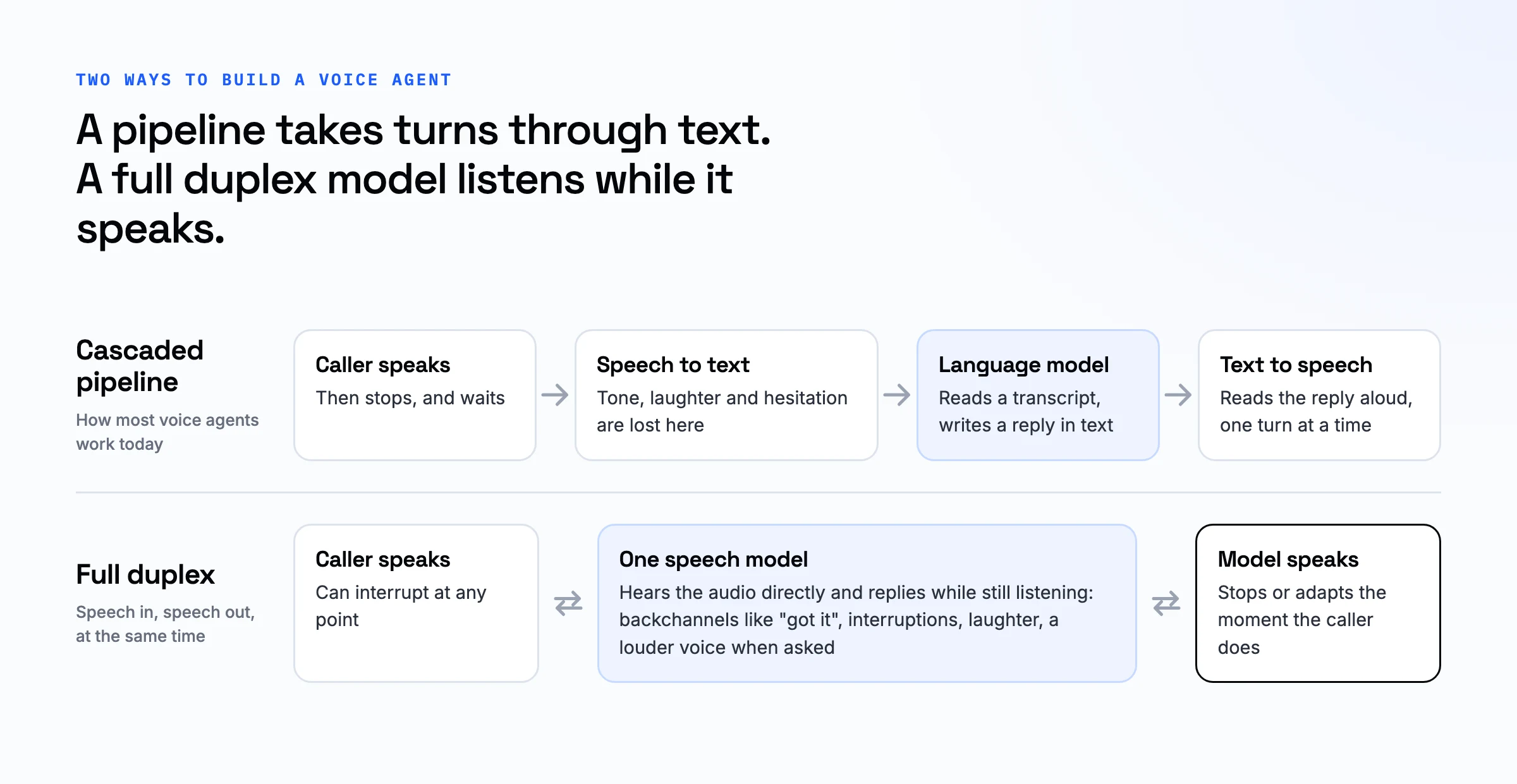
A full-duplex speech model removes the turn-taking and keeps the signal. That is why Dessa's demos feel different: the model is reacting to the sound of the conversation, not to a transcript of it.
What is notable about how it was built
Two claims stand out if they hold up.
The first is learning language from conversation alone. Large language models learn from vast amounts of written text. Learning from far fewer words, all of them spoken, suggests that speech carries a lot of structure that text leaves out.
The second is size. Training on one rack and running on a laptop points towards voice models that can live on a device. For businesses, that matters for privacy, for cost per conversation and for settings where audio should never leave the building.
What we do not know yet
It is worth being clear about the gaps before drawing conclusions:
- No published paper, parameter count, dataset size or formal benchmarks.
- No latency figures beyond "faster than real time".
- No public weights, licence or API.
- No word on languages, accents or noisy phone lines.
- No detail on how a model with no text interface follows written instructions or company policy, calls tools such as a booking system, or is evaluated and audited.
That last point matters most for business use. A customer service agent has to look things up, take actions and stay within rules. In a cascaded system, those controls sit on the text in the middle. A speech-only model will need new ways to do the same job.
What this means if you are building a voice agent now
Our advice is not to wait for any single model, but to build so you can take advantage of models like this when they are ready.
- Keep the speech layer swappable. Design the agent so the voice model can change without rewriting the business logic, the tools or the guardrails around them.
- Measure the conversation, not just the answer. Test how the agent handles interruptions, long pauses, people talking over it and frustrated callers, not only whether its replies are correct.
- Keep a record you can audit. Whatever the architecture, you need to know what the agent heard, what it decided and what it did. Plan for that before you change models.
- Tell people they are talking to AI. The more human a voice sounds, the more important clear disclosure becomes. Block itself has invited safety researchers in early because of risks like this.
- Watch on-device options. If models of this kind can run locally, some use cases that were ruled out on privacy grounds may open up.
Voice is moving from a turn-based interface to something closer to real conversation. The teams that benefit will be the ones whose systems are ready to adopt a better voice model the day it is proven, without starting again.
If you are planning a voice agent and want to work through the design, we can help. Book a discovery call.
Cover image: a screenshot of one of the conversation demos on Block's Dessa page.